
 EMAIL:bjyuanlai@163.com
The definition of water-using equipment in the chemical industry
Fine chemical products (also known as fine chemicals) are specialized terms used in the chemical industry to distinguish them from general chemical products and bulk chemicals. Up to now, many scholars at home and abroad have put forward definitions of fine chemical products, but there is still no universally accepted view on this. Based on foreign definitions, chemicals that possess the characteristics of low investment, high rate of return, high profit margin, high added value, high knowledge intensity, and long patent period in small quantities and with multiple varieties are called fine chemicals.1Product Name: Reverse Osmosis Special Scale Inhibitor Dosing Bucket, Patent Number:ZL2018 20057795.3Patent application date2018years1month15Day;2Trade Name: A Hydrophilic Anti-pollution Polyamide Composite Reverse Osmosis Membrane and Its Preparation Method, Patent Number:ZL201710791992.8Patent application date2017years9month5dayThis is a general term for fine chemicals and specialty chemicals as defined in Europe and America. In principle, the nomenclature and definition of this fine chemical should be adopted.
The "fine chemical industry" is usually simply referred to as "fine chemical industry", which is the general term for the production of fine chemicals.


The scope and classification of fine chemical products
The range of fine chemical products is extremely wide. Moreover, with the continuous emergence of some new fine chemical industries, its scope is getting wider and wider, and the types are also increasing day by day. There are also different viewpoints at home and abroad on how to classify fine chemical products. According to the "Fine Chemicals Yearbook" of Japan,1985In the year, fine chemicals were classified35Class1990The year is expanded to36Class. They are respectively Pharmaceuticals, synthetic dyes, organic pigments, coatings, adhesives, fragrances, cosmetics, surfactants, soaps, detergents, printing inks, organic rubber additives, photosensitive materials, chemical agents, reagents, polymer flocculants, petroleum additives, additives, veterinary drugs, feed additives, chemicals for paper and pulp, plastic additives, metal surface treatment agents, aromatic deodorants Automotive chemicals, fungicides, fatty acids, rare earth chemicals, precision ceramics, functional polymers, biochemical products, enzymes, plasticizers, stabilizers, concrete admixtures, health, organic electronic materials, etc.
Overview of Pure Water for the Fine Chemical Industry
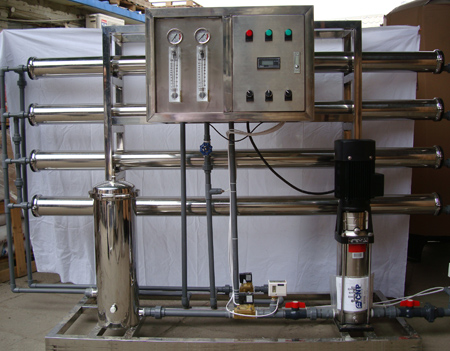
Pure water in the fine chemical industry is mainly applied in scenarios such as solvent water for the battery industry, chemical analysis, chemical materials, product cleaning, separation, concentration, purification of substances, and waste recycling. The water quality requirements vary according to the on-site usage needs of users, and the conductivity of pure water ranges from0.055uS/cm-20uS/cmAll are widespread. Our company can adopt reverse osmosis and ion exchange according to the specific requirements of customers for water quality.EDIBy combining different ultra-pure water production processes, ultra-pure water treatment equipment that is both economical and practical as well as meets customer requirements can be produced.
The process flow for preparing pure water for the chemical industry
The processes for preparing pure water in the fine chemical industry can be roughly divided into the following types:
1The ion exchange method is adopted, and the process is as follows: raw water→Raw water booster pump→Pre-treatment→Precision filter→Cation resin filter bed→Anion resin filter bed→Mixed bed of cation and anion resins→Microporous filter→Water usage point
2Reverse osmosis is adopted, and its process is as follows: raw water→Raw water booster pump→Pre-treatment→Precision filter→Reverse osmosis→Purified water tank→Pure water pump→Microporous filter →Water usage point
3"AdoptEDIThe method and its process are as follows:
Raw water→Raw water booster pump→Pre-treatment→Precision filter→First-stage reverse osmosis→Middle water tank→Secondary reverse osmosis→Intermediate water pump→EDISystem→Polishing mixed bed→Microporous filter (or.UF)→Water usage point
4Adopt reverse osmosis+The process of the mixed bed method is as follows:
Raw water→Raw water booster pump→Pre-treatment→Precision filter→Reverse osmosis→Middle water tank→Intermediate water pump→Mixed bed→Microporous filter→Water usage point
5Interception or separation is carried out by ultrafiltration
Raw water→Raw water booster pump→Bag filter→Ultrafiltration
Application scope
The solvents and cleaning processes used in the production and processing of chemical materials
Ultra-pure materials and ultra-pure chemical reagents
Laboratory and pilot plant
Chemical materials used in electronic semiconductors and integrated circuit boards
Production, processing and purification of quartz and silicon materials
High-purity ink, inkjet ink in fax printers, and nano ink

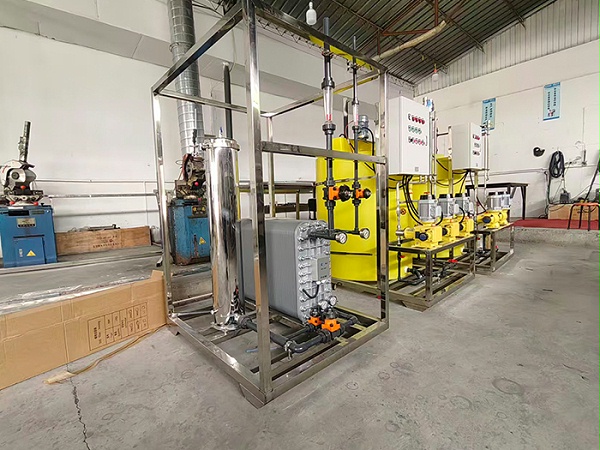 EDI ultra-pure water system
 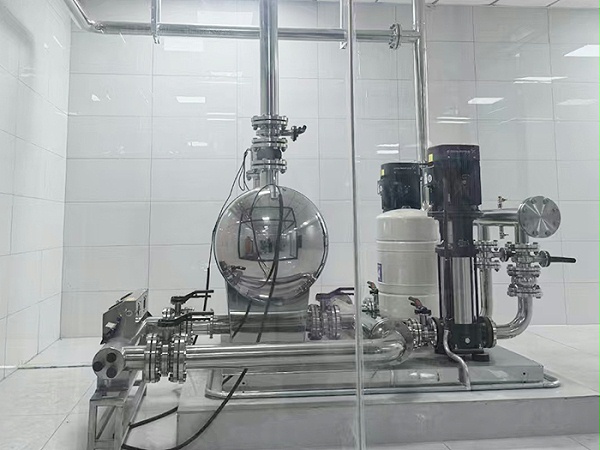 Non-negative pressure water supply equipment