
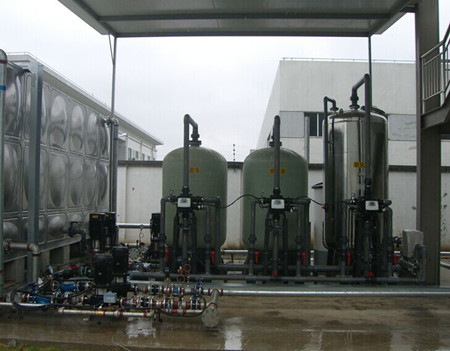
The working principle of softening: Softening technology is an ion exchange device that fills cation exchange resin in an exchange container. Its full name is cation exchange column, and it is abbreviated as softening bed. The application of softening beds: Softening beds are generally used before reverse osmosis devices to reduce or remove waterCa2+,Mg2+The effect of ions prolongs the time for inorganic salt scaling in reverse osmosis systems and protects the reverse osmosis membrane system. It can also be setEDIIn front of the electro-deionization device, enterEDI"Water"......
 EMAIL:bjyuanlai@163.com
Softening working principle
Softening technology is an ion exchange device in which cation exchange resin is filled in an exchange container. Its full name is cation exchange column, and it is abbreviated as softening bed.
The application of softened beds
Softening beds are generally applied before reverse osmosis devices to reduce or remove waterCa2+,Mg2+The effect of ions prolongs the time for inorganic salt scaling in reverse osmosis systems and protects the reverse osmosis membrane system. It can also be set EDIIn front of the electro-deionization device, enterEDIThe water quality meets the influent requirements and is preventedEDIMembrane block scaling affects the effluent quality. In addition, softening beds are typically used in the medium and low pressure boiler make-up water industry and in process water applications such as chemical engineering and papermaking, to reduce the hardness of water.
I. Overview
A multi-way valve is a type of valve designed with multiple paths within the same valve body. The controller issues instructions to the multi-way valve limit according to the pre-set program, and the multi-way valve automatically completes the opening and closing of each valve, thereby achieving various process procedures such as operation, backwashing, regeneration, and forward washing. The multi-way valve system mainly consists of multi-way valves, controllers, resin tanks and salt tanks.
Ii. Application Scope
It is widely used in the preparation of industrial and civil softened water, such as: boiler water supply, heating, supplementary water for air conditioning systems, and good domestic water supply, etc.
Iii. Characteristics
1It has a high degree of automation 2Low operating costs 3It occupies a small area 4It operates stably and reliably
"Multi-valve system
Due to the limitation of the multi-way valve's diameter, when the water production is greater than50t/hAt this time, the multi-way valve system will exhibit the disadvantages of complexity, increased cost and accidents. At this point, it is suitable to adopt a multi-valve system.
The multi-valve system is mainly composed of multiple automatic valve (hydraulic, pneumatic or electric) controllers, resin tanks and salt tanks. The controller issues instructions to each automatic valve respectively according to the pre-set program to complete the opening and closing of each passage, thereby realizing the various process procedures of operation regeneration.
The characteristics of multi-valve systems are flexible operating conditions and easy control and adjustment. The regeneration method can be either co-current or counter-current. Especially, multi-valve control avoids the situation where the diameters of multiple valves are small (usually less than)3The disadvantage that only multiple tanks can be used when there is a large flow rate. with4"Automatic valve control, with a multi-valve system, the water treatment volume of a single tank can be achieved.50t/hThat's all.

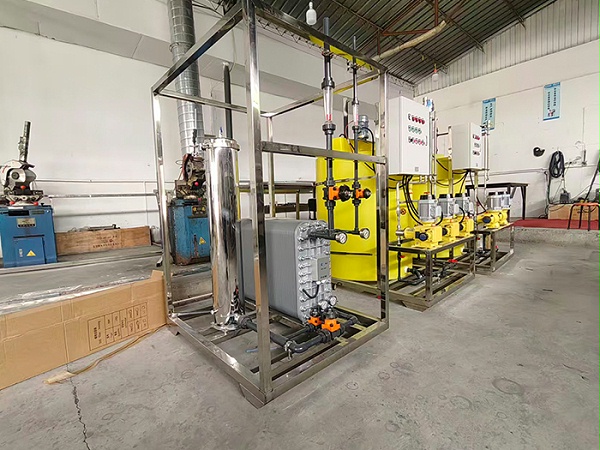 EDI ultra-pure water system
 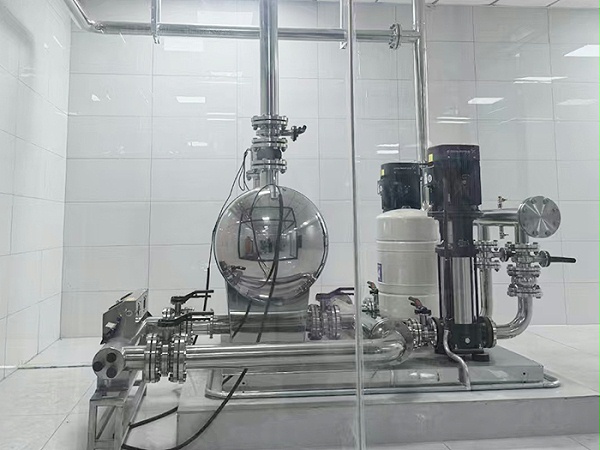 Non-negative pressure water supply equipment