
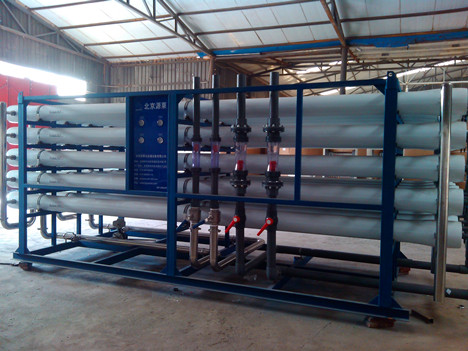
Introduction to Reverse Osmosis: The original text of reverse osmosis isREVERSEOSMOSIS--(ROIt was developed by NASA in collaboration with scientists from multiple countries, with government support, at a cost of billions of dollars and after years of research. It was initially used to recycle and process the domestic water of astronauts, making it drinkable again, thus eliminating the need for spacecraft to carry large amounts of drinking water. Therefore, it is called space technology. The water it produces is also calledquot"Space water"quot. In recent years, it has developed rapidly in our country. Reverse osmosis......
 EMAIL:bjyuanlai@163.com
Introduction to Reverse Osmosis
Reverse osmosis is the original textREVERSE OSMOSIS--(ROIt was developed by NASA in collaboration with scientists from multiple countries, with government support, at a cost of billions of dollars and after years of research. It was initially used to recycle and process the domestic water of astronauts, making it drinkable again, thus eliminating the need for spacecraft to carry large amounts of drinking water. Therefore, it is called space technology. The water it produces is also called""Space water"". In recent years, it has developed rapidly in our country. Reverse osmosis involves applying a pressure greater than the osmotic pressure to a solution, allowing water to pass through a specially designed semi-permeable membrane and be separated from the solution. Because this process is opposite to the osmosis phenomenon, it is called reverse osmosis. According to the different osmotic pressures of various materials, reverse osmosis with a pressure greater than the osmotic pressure can be used for a certain solution to achieve the purpose of separation, extraction, purification and concentration of the solution. It can remove organic substances with a very small ionic range and molecular weight in the filtrate, such as viruses and pyrogens.
Reverse osmosis devices mainly separate the ion range in solutions. They do not require heating and have no phase change process, so they consume less energy than traditional methods. Reverse osmosis devices are small in size, easy to operate and have a wide range of applications. Reverse osmosis devices are used to treat industrial water. They do not consume a large amount of acid and alkali, cause no secondary pollution, and have relatively low operating costs. Water treated by reverse osmosis has a high purity. It can not only remove impurities in the ionic range, but also eliminate organic pollutants, microorganisms, viruses and pyrogens, etc., which are difficult to remove by other methods.

The working principle of reverse osmosis
1. Osmosis and osmotic pressure
Infiltration is a common phenomenon in nature,For example, put a cucumber into salt water,Cucumbers will become smaller due to water loss. The process by which water molecules in cucumbers enter a salt water solution is called osmosis. As shown in the following figure,If a pool is divided into two parts by a film through which only water molecules can pass,Inject pure water and salt water to the same height on both sides of the diaphragm respectively. After some time, it can be found that the liquid level of pure water has dropped, while that of salt water has risen. We call the phenomenon where water molecules migrate through this membrane into salt water osmosis. The rise of salt water level is not endless. When it reaches a certain height, it will reach a balance point. At this time, the pressure represented by the liquid level difference at both ends of the diaphragm is called osmotic pressure. The magnitude of osmotic pressure is directly related to the concentration of salt water.
2. Reverse osmosis phenomena and reverse osmosis water purification technology
After the above devices reach equilibrium,If a certain pressure is applied to the liquid surface at the salt water end, at this time, water molecules will migrate from the salt water end to the pure water end. The phenomenon where liquid molecules migrate from a dilute solution to a concentrated one under pressure is called reverse osmosis. If salt water is added to one end of the above facility and a pressure exceeding the osmotic pressure of the salt water is applied at that end, we can obtain pure water at the other end. This is the principle of reverse osmosis water purification.
There are two key factors for reverse osmosis facilities to produce pure water: one is a selective membrane, which we call a semi-permeable membrane, and the other is a certain pressure. Simply put, there are numerous pores on the reverse osmosis semi-permeable membrane, and the size of these pores is comparable to that of water molecules. Since viruses, most organic pollutants and hydrated ions are much larger than water molecules, they cannot pass through the reverse osmosis semi-permeable membrane and are separated from the water that passes through it. Among the numerous impurities in water,Dissolved salts are difficult to clean.Therefore,The water purification effect of reverse osmosis is often determined by the level of desalination rate.The desalination rate of reverse osmosis mainly depends on the selectivity of the reverse osmosis semi-permeable membrane. At present, the desalination rate of reverse osmosis membrane elements with high selectivity can be as high as99.7%.

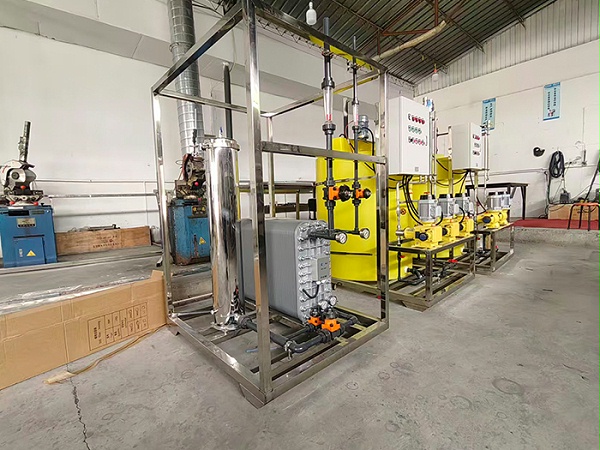 EDI ultra-pure water system
 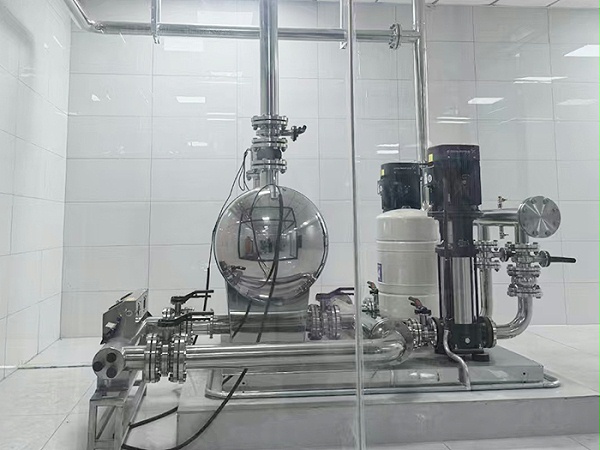 Non-negative pressure water supply equipment